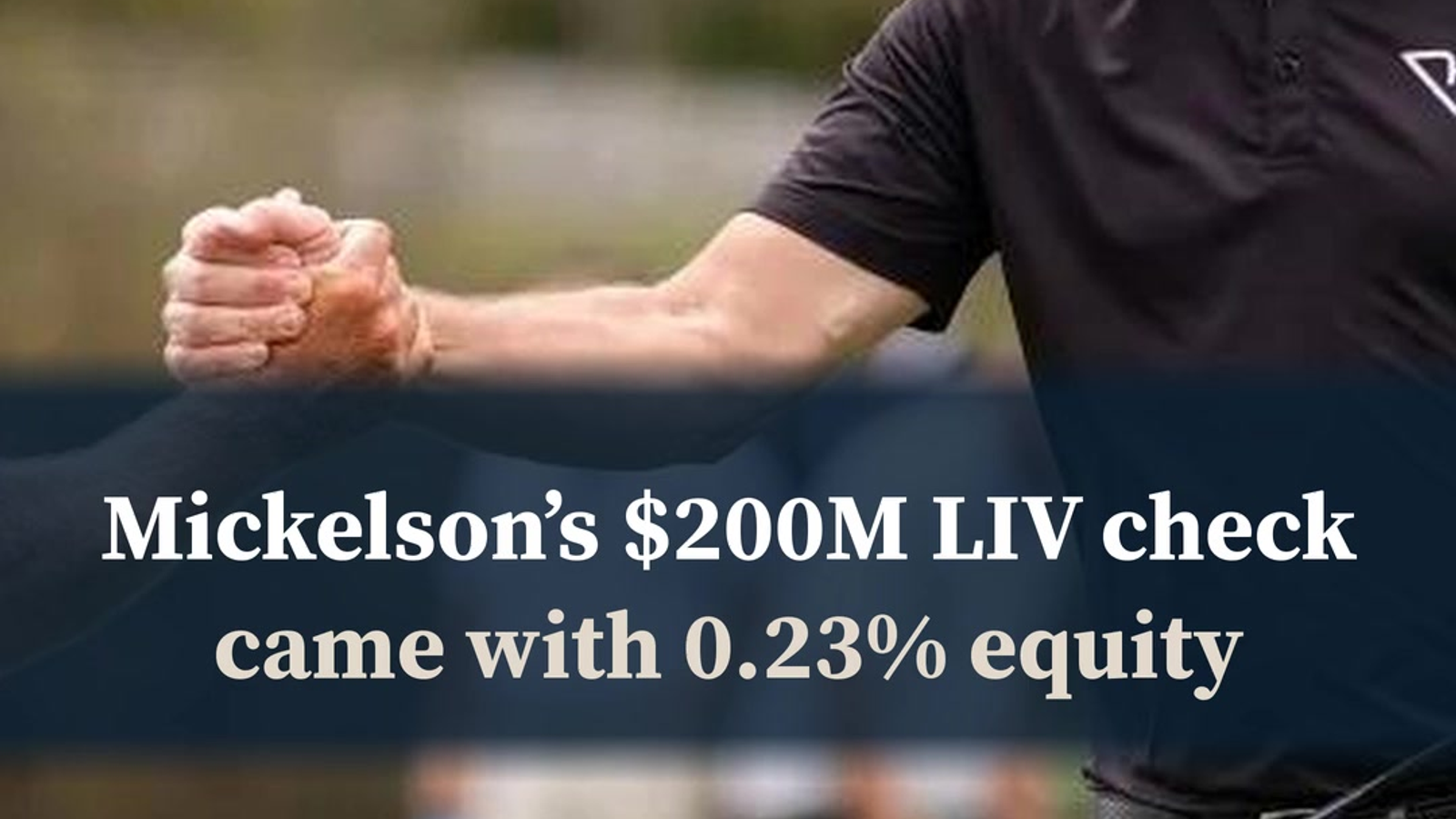
Phil Mickelson fist-bumping another LIV Golf player on the course. Governance

Phil Mickelson's LIV Money Was Never Just $200 Million

He took equity over cash on a calculated bet. LIV's Chapter 11 filing is what that bet is worth now.

By Alex Kagianaris, Esq. Sep 17, 2026

LIV Golf filed for Chapter 11 bankruptcy protection in the U.S. Bankruptcy Court for the District of New Jersey. Sportico, reporting on the filing, identified Phil Mickelson as the unnamed "current player" holding a 0.23% equity stake in the entity, alongside a cap table showing the Public Investment Fund at 98.48%, PIF-controlled Performance54 Group at 1.05%, and former CEO Greg Norman also at 0.23%. Mickelson signed with LIV in 2022 for a package reported at approximately $200 million, structured as a cash guarantee. He also held a separate 25% stake in the HyFlyers GC team he captained, reported at the same time. The 0.23% stake in LIV Golf itself identified in the bankruptcy filing is distinct from the HyFlyers team stake, and its origin -- whether from the 2022 signing or some later arrangement -- is not established by the sourcing available here. The filing is the first point at which that bet has been tested against an actual insolvency proceeding rather than against speculation about LIV's prospects. A cap table filed in a Chapter 11 case is not a projection or a reported valuation; it is a document filed with a federal court stating who owns what percentage of the debtor, which becomes directly relevant to how any plan of reorganization treats each class of claim and interest. That reported $300 million recapitalization is not a separate, uncertain track -- it is a signed Restructuring Support Agreement with BC Partners Credit, filed alongside the bankruptcy petition itself. The term sheet splits the financing into a $127.5 million term loan carrying warrants for 5% of the reorganized entity, $147.5 million in preferred equity carrying warrants for another 10%, and $25 million in convertible notes that would eventually convert to 30% -- putting BC Partners at 45% of the reorganized company, with players collectively holding 52.5% and management 2.5%. The agreement carries a 35-day deadline, running to October 13, 2026, requiring player-creditors representing at least two-thirds of claim value and half of claim count to sign on. PIF, meanwhile, is exiting the company entirely, funding only a $49.6 million debtor-in-possession loan to carry operations through the case. Equity in a company under majority control by one investor is a residual claim, not a payable obligation. In a Chapter 11 priority waterfall it ranks behind unsecured creditors, sitting closer to the bottom of the distribution than the top. It absorbs the first losses when a capital structure fails, and confirms last, if at all, when one succeeds. Any equity position taken in place of additional guaranteed cash is a bet on enterprise value outrunning a fixed payout — and it is a bet whose downside was always visible in the instrument itself, not hidden in fine print. Whatever the exact mechanism or timing behind Mickelson's 0.23% stake in LIV Golf, that position is what a Chapter 11 filing is now testing. A 0.23% stake in a Chapter 11 debtor is worth exactly what the waterfall says it's worth once the company that issued it can't pay its bills — not because equity compensation is inherently unwise, but because equity, at that rank, was never going to be worth more than the company's remaining value after every senior claim is paid. The mechanics matter here because the difference between "owed money" and "owns equity" is where this story turns. A creditor has a claim against the estate that gets paid, in whole or in part, before equity holders see anything. Equity holders are last by definition — they own what remains after every other claim is satisfied, and in a filing serious enough to reach Chapter 11, what remains is frequently nothing. There is a further wrinkle specific to this cap table. PIF holds both the overwhelming equity position, at 98.48%, and is presumably a primary source of any rescue financing or plan funding. A reorganization plan shaped by the party that already owns nearly all the equity and stands to fund the company's exit from bankruptcy is not negotiated the way a plan gets negotiated among diffuse, unrelated equity holders. Whatever recovery flows to the 0.23% lines on that cap table will be shaped substantially by what the majority holder proposes. What matters is the split nobody discusses in public once the headline number lands: guaranteed cash is a claim on the paying entity's bank account regardless of what happens to the company later; equity is a claim on the entity's future value, contingent on that value existing at all. Mickelson's package combined a $200M cash guarantee with equity positions on top of it — the HyFlyers team stake reported in 2022, and the LIV Golf stake the bankruptcy filing now reveals. It is the equity piece, not the guarantee, that a Chapter 11 filing puts to the test. Because PIF holds the overwhelming majority of LIV's equity and is presumably a primary source of any rescue financing or plan funding, any reorganization plan it proposes or heavily influences would not be negotiated the same way a plan gets negotiated among diffuse, unrelated equity holders, and recovery to the minority equity lines on the cap table would be shaped substantially by what the majority holder proposes rather than by adversarial negotiation among equal parties. Watch the Chapter 11 proceeding for the actual priority order the court confirms -- that is what will settle, as a matter of record rather than reporting, where the 0.23% player-equity line actually sits relative to unsecured creditors.

Continue reading →
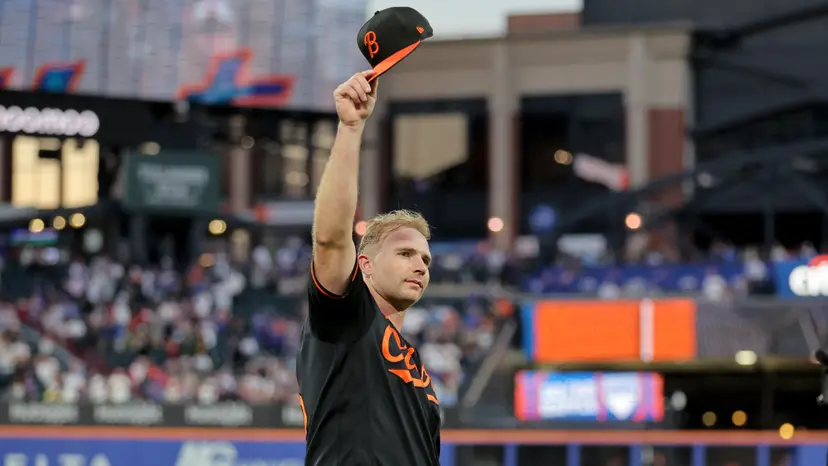
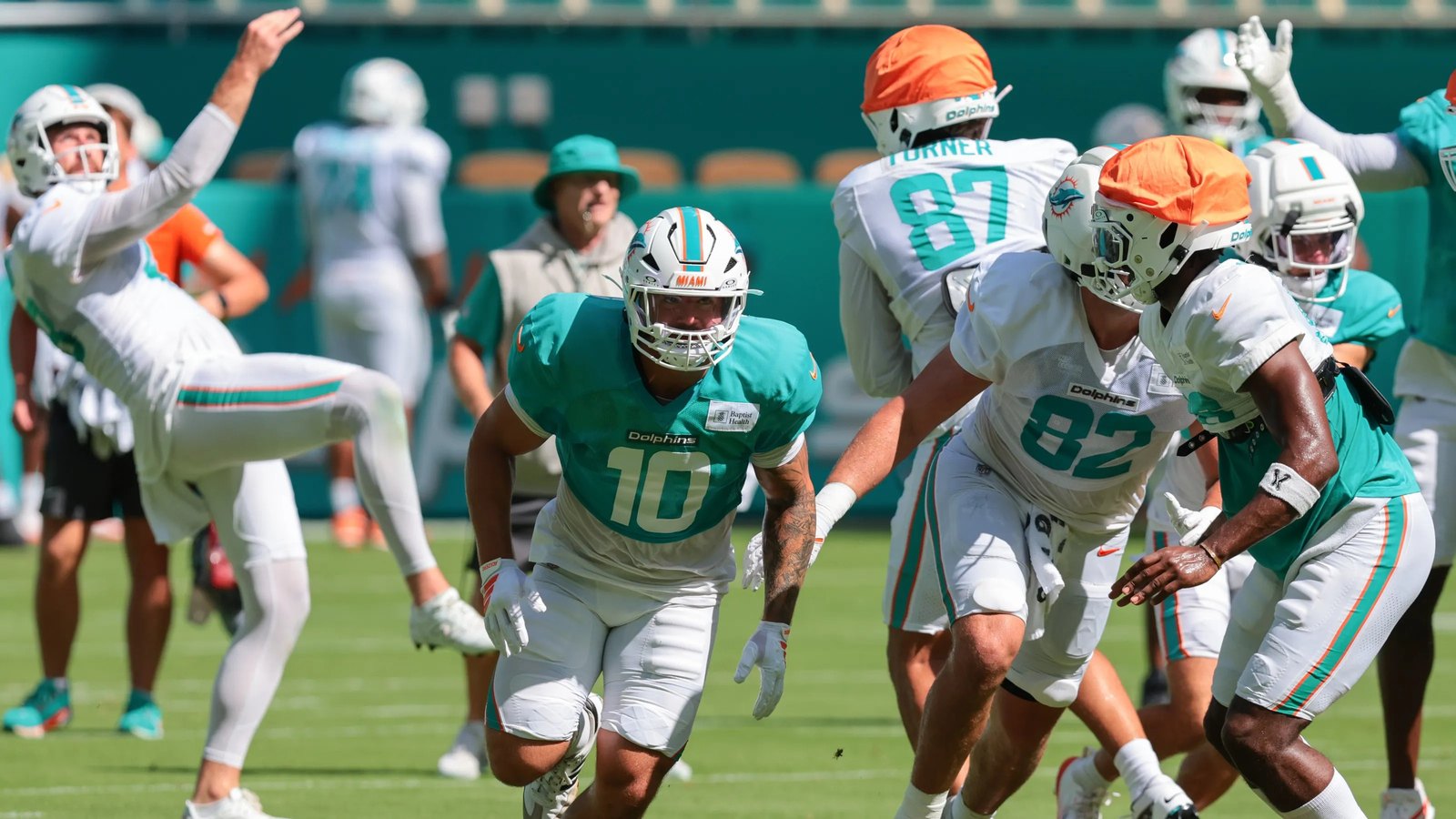
Baltimore Orioles' Pete Alonso tips his cap to the crowd at Citi Field Labor & CBA Did the "Cohen Tax" Work or Backfire? A mechanism built to make Steve Cohen's spending more expensive appears to have helped push the Mets' home run leader out the door -- and he hit a career milestone against them months later. By Alex Kagianaris, Esq. Miami Dolphins players running a drill in helmets and practice jerseys during a training camp session, with coaching staff and equipment visible along the sideline. Contract Five of Miami's Top Six Salaries Aren't on the Team. The Dolphins are carrying an all-time record $182.29 million in dead cap. It was built on purpose. By Alex Kagianaris, Esq.

The Latest

See all →

Legal tracker →

The Archive

Enter the Archive →

The precedent behind today's sports.

  1. 1922 Federal Baseball The Supreme Court ruled that baseball wasn't interstate commerce — a legal fiction even at the time — and granted MLB a full antitrust exemption no other league has ever gotten. A century of exceptions, protections, and leverage baseball's owners have used ever since traces back to this one holding. The exemption everyone assumes is normal is actually the outlier.
  2. 1971 Haywood Haywood left college early, signed with a rival league, then tried to enter the NBA before its mandatory four-year waiting period was up. The league said no. The Court let him play. Every underclassman who has entered a draft early since is standing on Haywood's exception.
  3. 1971 Ali v. United States Muhammad Ali refused induction into the armed forces in 1967 on religious grounds and was convicted of draft evasion. His local board had denied him conscientious-objector status without stating why. The Justice Department's own letter to the appeal board had offered three separate grounds for denying the claim, and by the time the case reached the Supreme Court the Court could not determine which of the three the board had actually relied on. Unable to review a decision that gave no reasons, the Court reversed the conviction unanimously, 8-0.
  4. 1972 Flood Curt Flood refused a trade and sued the reserve clause directly, all the way to the Supreme Court — and lost. The Court acknowledged baseball's antitrust exemption was an anomaly, then upheld it anyway on legal inertia. Flood's loss did something his win couldn't have: it convinced the players' union that courts weren't the way out. Three years later, they found a technicality instead.
  5. 1972 Title IX Thirty-seven words, and none of them mention sports: no person shall, on the basis of sex, be excluded from participation in, denied the benefits of, or subjected to discrimination under any education program or activity receiving federal financial assistance. Congress was not writing an athletics statute. It became one, because school athletic programs are federally funded education programs, and the statute does not exempt them.
  6. 1975 Messersmith–McNally Marvin Miller had two pitchers play an entire season without signing new contracts — on purpose. When the season ended, he argued their old deals' one-year renewal clause had already been used up. The arbitrator agreed. No valid contract, no reserve right. Modern free agency wasn't born from a lawsuit. It was born from a technicality nobody else had thought to exploit.
  7. 1976 Robertson Oscar Robertson lent his name to a six-year antitrust fight against the NBA's reserve clause — and against a proposed merger with the ABA that would have killed competing bids for every player in the league. The settlement landed the same year the merger did. Block the merger, and the reserve clause had nowhere left to hide.
  8. 1993 Reggie White The NFLPA did something almost nobody expects a union to do: it dissolved itself. No union, no labor exemption protecting the league's employment rules from antitrust scrutiny. Reggie White and the other plaintiffs sued directly — and won the free agency and salary cap system the NFL still runs on. Sometimes the fastest way to gain leverage is giving up the thing that was limiting you.
  9. 2001 PGA Tour v. Martin A tour golfer with a circulatory condition asked to ride between shots. The PGA Tour said walking was a substantive rule of competition and that waiving it for anyone would fundamentally alter the event. The Court disagreed on both questions it faced: the tour is a place of public accommodation under the ADA, and letting one player ride did not alter the nature of the competition, because the rule the tour was defending was about fatigue rather than about shotmaking.
  10. 2010 American Needle The NFL argued its 32 teams were legally a single entity when they licensed merchandise together — meaning antitrust law couldn't reach how they carved up that business. A unanimous Supreme Court said no: 32 separately owned teams acting together is exactly the kind of coordination antitrust law exists to watch. Every modern licensing, merchandise, and media rights arrangement still has to clear the standard this case set.
  11. 2018 Murphy v. NCAA New Jersey wanted to repeal its own ban on sports betting, and a federal statute said it could not. The Court held that PASPA's prohibition on state authorization commandeered the states: Congress may regulate sports gambling itself, but it cannot order a state legislature to keep a prohibition on its books. The decision did not legalise anything. It removed the federal instrument that had kept every state but a handful out of the market, and the states moved into the space within months.
  12. 2019 Semenya The IAAF's 2018 Eligibility Regulations required certain female athletes with a 46 XY chromosome pattern and natural testosterone above 5 nmol/L to medically lower it to compete in events from 400 meters to the mile. Caster Semenya and Athletics South Africa challenged the regulations before the Court of Arbitration for Sport as discriminatory, unnecessary, unreliable, and disproportionate. A three-member panel found, 2-1, that the regulations were indeed discriminatory on their face -- and ruled for the IAAF anyway, holding that discrimination in sport is lawful if it is a necessary, reasonable, and proportionate means to a legitimate aim. Semenya declined to lower her testosterone and has not competed in her preferred events since.
  13. 2021 Alston A unanimous Supreme Court struck down the NCAA's limits on education-related benefits — a narrow ruling, on paper. But Justice Kavanaugh's concurrence said the rest of the NCAA's compensation rules wouldn't survive the same scrutiny if challenged directly. The NCAA didn't wait to find out. Days later, NIL was permitted.
Enter the Archive →

The Verdict, in your inbox

The week's most consequential stories in sports, read the way a lawyer reads them.

Fridays. Free. Commentary, not legal advice. Unsubscribe in one click. By subscribing you agree to our Privacy Policy and Terms. What you're signing up for →