
Did the "Cohen Tax" work or backfire?
A mechanism built to make Steve Cohen's spending more expensive appears to have helped push the Mets' home run leader out the door -- and he hit a career milestone against them months later.
I. What happened
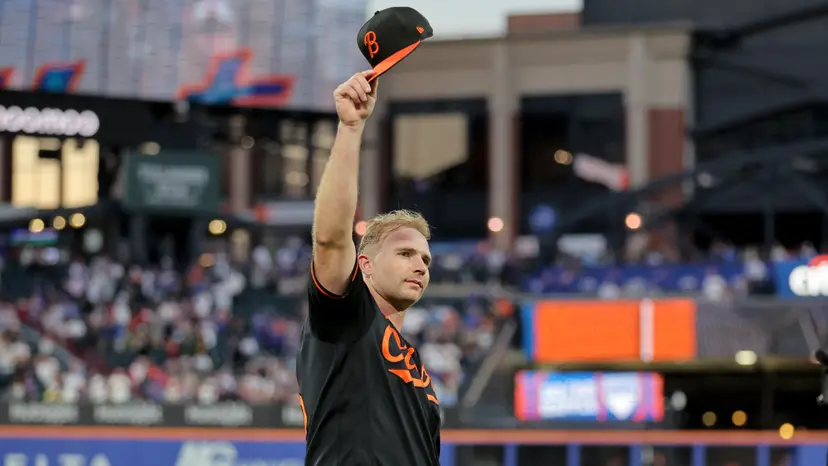
Pete Alonso hit the 300th home run of his career Tuesday night at Citi Field, a game-tying solo shot off Kodai Senga in the top of the ninth inning, as the Baltimore Orioles beat the Mets 7-5 in 11 innings. It was his first season with Baltimore after signing a five-year, $155 million contract in December 2025, following the Mets' decision not to make a competitive offer after Alonso opted out of his prior deal.
The reaction across his return series was pointed. In his first game back Monday night, after flying out in his first at-bat, Citi Field crowds broke into a "Fire Stearns" chant directed at Mets president of baseball operations David Stearns. The following night, that same fan base gave Alonso -- now wearing an opposing uniform -- a curtain call after his 300th home run tied the game.
II. What law or rule controls
The fourth competitive balance tax threshold, added in the 2022 CBA, sits $60 million above the base tax line and carries a marginal surcharge of up to 110% on spending beyond it, with draft-pick penalties for teams exceeding it in consecutive seasons. It's informally known as the "Cohen Tax," a direct reference to Mets owner Steve Cohen, whose spending pattern in the years immediately following the 2022 CBA prompted its inclusion -- Cohen himself acknowledged as much in March 2022, telling reporters the Mets would "probably" exceed the new fourth tier that season. The mechanism is a cost, not a compulsion: it does not bar a team from spending past the line, it prices doing so.
III. Where does the law stand now
The Mets' finalized 2025 luxury tax bill was $91.6 million -- the second-highest in MLB behind only the Dodgers -- bringing their total tax paid over four years under Cohen to $320.3 million. That figure is not a projection; it was finalized by MLB and the players' union and reported by the Associated Press in December 2025, after the Alonso decision had already been made. Cohen himself had already signaled where this was headed back in March 2022, telling MLB.com's Anthony DiComo the Mets would "probably" exceed the new fourth tier that season, calling $290 million "a lot of money to spend overall" while saying he was "OK with it" and "willing to live with it."
But the mechanism itself is now unsettled in a much larger way than any single team's bill. The current CBA expires December 1, 2026, and the entire four-tier CBT structure -- the fourth threshold, the Cohen Tax nickname, all of it -- exists only because that 2022 agreement created it. MLB's owners have proposed replacing the whole system with a hard salary cap for the first time since the 1994 strike: a $245.3 million ceiling paired with a $171.2 million floor, presented to the union on May 28, 2026, alongside a proposed 50/50 revenue split with a portion of player salaries held in escrow against revenue shortfalls.
The MLBPA, under interim executive director Bruce Meyer, has called a cap "a form of institutionalized collusion" and remains opposed. Meyer has been specific about the number: using MLB's own definitions of revenue and player share, he estimates the proposal would have cost players more than $500 million in 2026 alone had it already been in place. A work stoppage after the current deal lapses is widely expected around the league -- exactly what Alonso himself predicted more than a year before it became the story.
So the specific mechanism that shaped Alonso's departure -- the fourth CBT tier as it existed in 2025 -- may not exist in that form past this offseason. Whatever replaces it, if anything does, will be negotiated under active threat of a lockout, not calmly reasoned through.
IV. Who has leverage
The honest answer is probably the least satisfying one: the tax didn't force the outcome, but it wasn't irrelevant to it either. It functioned as a real, quantifiable thumb on the scale in a decision that likely would have been close regardless -- raising the effective price of "yes" at exactly the moment the front office was already weighing whether Alonso's next contract made baseball sense.
That's a meaningfully different claim than "the tax pushed him out." A tax that adds real, compounding cost to a marginal decision is doing its job as a deterrent; whether it was the deciding factor or just one more weight on a scale that was already tipping is something only the room that made the call actually knows. From the outside, all the tax proves is that if the Mets were close to walking away anyway, it gave them one more real number to point to on the way out the door.
It's not "the rule beat Cohen." It's that a rule built to make his spending style more expensive did its one job, in a decision where a straight baseball judgment might have gotten to the same place regardless.
V. The lawyer's read
The tax did its one job -- raising the price of a decision that might have gone the same way regardless. That's not the rule beating Cohen. It's the rule working.
VI. What happens legally next
The current CBA expires December 1, 2026. Owners and the union remain far apart on the proposed hard cap, and a lockout after the deal lapses is widely expected league-wide -- Alonso himself predicted this fight directly, telling reporters at the 2025 All-Star Game, while still a Met, "No one's talking about it, but we all know that they're going to lock us out for it, and then we're going to miss time." The player at the center of tonight's story was on record forecasting the exact confrontation now unfolding around the mechanism that shaped his own free agency.
Claims
10 claims: 10 verified.
Table of authorities
Primary sources
Authorities cited
- Pete Alonso hits 300th career home run against MetsLeague statement
- Orioles' Pete Alonso greeted warmly in return to Citi FieldFiling
- Pete Alonso, Orioles contract: 5 years, $155 millionAgreement
- Steve Cohen says Mets will 'probably' exceed MLB's new $290 million luxury-tax tierFiling
- Dodgers hit with record $169M luxury tax after 2nd straight titleFiling
- Breaking down initial MLB CBA proposals: Salary cap and moreFiling
- MLBPA negotiator sees clear distance between 2 sides of CBAFiling
- A lockout is looming over MLB in December 2026Filing
10 claims: 10 verified.
Commentary and analysis, not legal advice. No attorney-client relationship is formed through this content. Descriptions of pending matters reflect publicly reported information as of the publication date.