
Five of Miami's top six salaries aren't on the team.
The Dolphins are carrying an all-time record $182.29 million in dead cap. It was built on purpose.
I. What happened
The Miami Dolphins carry a reported $182.29 million in dead cap for 2026 — an all-time NFL figure, against a previously reported ceiling of roughly $130 million for any club. Defensive tackle Zach Sieler, at a reported $11.4 million, is the highest cap charge among players actually on the active roster.
Five players no longer with the club carry larger charges than any active player: Tua Tagovailoa, Tyreek Hill, Jaylen Waddle, Jalen Ramsey, and Minkah Fitzpatrick.
None of these figures come from a league or club filing. Cap accounting is not publicly disclosed, and every number here traces to cap databases and reporting.
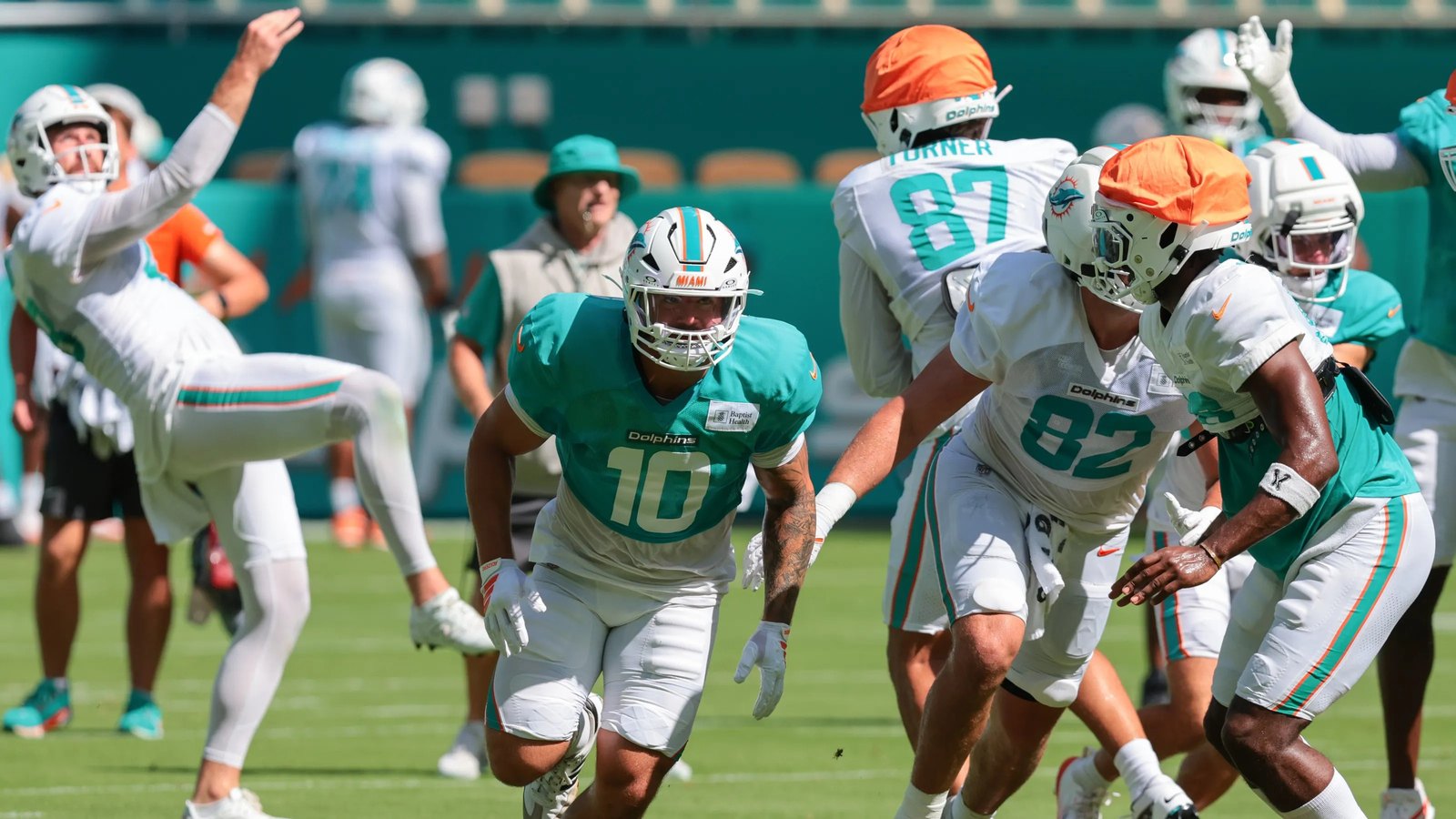
II. The legal angle
Dead cap is not a penalty and not an accounting error. It is the arithmetic of a mechanism clubs use deliberately, running in reverse.
Proration. Under Art. 13, § 6(b)(i), the total signing bonus is prorated over the term of the contract on a straight-line basis, to a maximum of five years. A club paying $50 million in bonus on a five-year deal charges $10 million per year rather than $50 million at signing. This is why bonus exists as a category: it is the lever that converts present cash into deferred cap.
The total amount of any signing bonus shall be prorated over the term of the Player Contract, with a maximum proration of five years.CBA
Acceleration, and which year absorbs it. Section 6(b)(ii) governs what happens when the allocation outlives the contract, and the timing turns on a single date. Under § 6(b)(ii)(1), a contract terminated on or before June 1 puts the unamortized amounts into Team Salary for that same League Year. Under § 6(b)(ii)(2), a termination after June 1 sends the future unamortized amounts fully into Team Salary at the start of the next League Year.
So "the charge accelerates" is incomplete as stated. It accelerates into one of two League Years, and which one is a scheduling decision the club makes.
The designation. § 6(b)(ii)(1) permits a club, in each League Year preceding the Final League Year, to designate up to two contracts terminated on or before June 1 to be treated as if terminated on June 2 — routing future unamortized amounts into the next year under Subsection (2). The current year's ordinary proration stays where it is; the future amounts move. The total is unchanged. The condition attached is that the contract must not have been renegotiated after the last regular-season game of the prior League Year, which is a meaningful limit given that restructuring is exactly what creates large unamortized balances.
Run those together and Miami's figure explains itself. Multiple large bonuses, prorated forward, with the players removed before the allocations ran. Each departure accelerated its own remainder, and the designations moved some of it into 2026 rather than reducing it.
The distinction worth drawing. Cleveland's position with Deshaun Watson is often grouped with this one. They are structurally different. Cleveland's charge is the residue of a contract the club wanted out of and could not affordably leave. Miami's is the cost of a reset the club chose. Same provisions, opposite intent — which is why "record dead cap" tells you almost nothing on its own.
III. Follow the money
The number is large because the conversions were large, not because the rules were applied unusually.
Every restructure moves cap cost forward. A restructure late in a contract moves it into fewer remaining years, so each of those years carries more, so acceleration concentrates. A club that restructures repeatedly to stay compliant is borrowing from a shrinking number of future seasons.
Miami is reported to have used post-June 1 designations on at least two contracts, with roughly $55.4 million of the 2026 total attributed to the 2026 half of one of them. That is the informative detail: the tool that moves future charges into the following year was applied, and the 2026 figure is still a record — which measures the volume of bonus involved rather than any failure to manage it.
Worth restating: none of these figures come from a filing. They are third-party reconstructions from reported contract terms, and different cap databases publish figures a few hundred thousand dollars apart. They should be read as close estimates.
IV. Who has leverage
Miami, in a way the headline obscures.
A club trapped by dead cap has no leverage. A club that chose it has already spent the money and now holds a roster with almost no long-term obligations attached. The relevant comparison is not to a healthy cap sheet but to the alternative — carrying those contracts forward, paying the same money more slowly, and fielding a roster built around players the front office had decided against.
The two players most often cited in coverage of this figure — Ramsey and Armstead — did play for Miami, across multiple seasons each, through the 2024 season. A charge attaches to a contract's bonus allocation rather than to snaps, so a departed contributor and a departed acquisition produce the same line on a cap sheet. That is a feature of the accounting, not evidence of a club paying for nothing.
The players and agents lose something here that is easy to miss. A club with a record dead-cap year has a defensible reason to decline every restructure request and offer no guaranteed money in the current cycle. "We cannot" is a stronger negotiating position than "we would rather not," and this front office can say it truthfully for at least one season.
The league office has an interest here too. Dead cap of this magnitude is a competitive-balance question in a system designed to prevent exactly that — a club effectively fielding a below-market roster for a season is a club not competing, and the cap exists to compress the range of outcomes rather than to permit deliberate excursions from it.
V. What happens next
Watch whether the 2027 sheet actually clears, because that is the entire thesis.
A reset works only if the charges are concentrated in one year and the roster rebuilds against a clean cap afterward. Any acceleration pushed forward by post-June 1 designations lands in 2027 by definition. If a meaningful share was deferred that way, 2027 is not clean, and what was described as a reset was a deferral.
That is calculable from the contract structure rather than from performance, and it is the number to check when the next league year opens.
The second thing to watch is behavioral, and it is the more reliable pattern. A front office that has just absorbed a record dead-cap year has every incentive to demonstrate the plan worked by spending aggressively the moment space appears. Aggressive spending against a suddenly clean cap is how the next round of large prorated bonuses gets signed — which is how a reset becomes a cycle.
One further consequence worth tracking: the record itself becomes a reference point. Front offices benchmark against precedent, and a club that has demonstrated an organization can absorb $182 million in a single year and continue operating has changed what the outer bound looks like for everyone else.
Claims
8 claims: 2 verified, 4 reported only, 2 retracted.
Table of authorities
Primary sources
Authorities cited
8 claims: 2 verified, 4 reported only, 2 retracted.
Corrections
- September 4, 2026
An earlier version stated that Jalen Ramsey and Terron Armstead carried dead-cap charges without having played a regular-season down for Miami. Both played multiple seasons for the club through 2024. The statement was incorrect and has been removed.
- September 4, 2026
An earlier version described the 2026 figure as more than double the previous mark. Reporting places the prior ceiling for any club at roughly $130 million, which the 2026 figure exceeds by about 40 percent rather than doubling. Corrected.
- September 4, 2026
An earlier version stated that unamortized bonus accelerates into the current league year on release. Under Art. 13 § 6(b)(ii), a termination after June 1 sends future unamortized amounts into the next League Year. The passage has been rewritten.
Commentary and analysis, not legal advice. No attorney-client relationship is formed through this content. Descriptions of pending matters reflect publicly reported information as of the publication date.