
Phil Mickelson's LIV Money Was Never Just $200 Million
He took equity over cash on a calculated bet. LIV's Chapter 11 filing is what that bet is worth now.
I. What happened
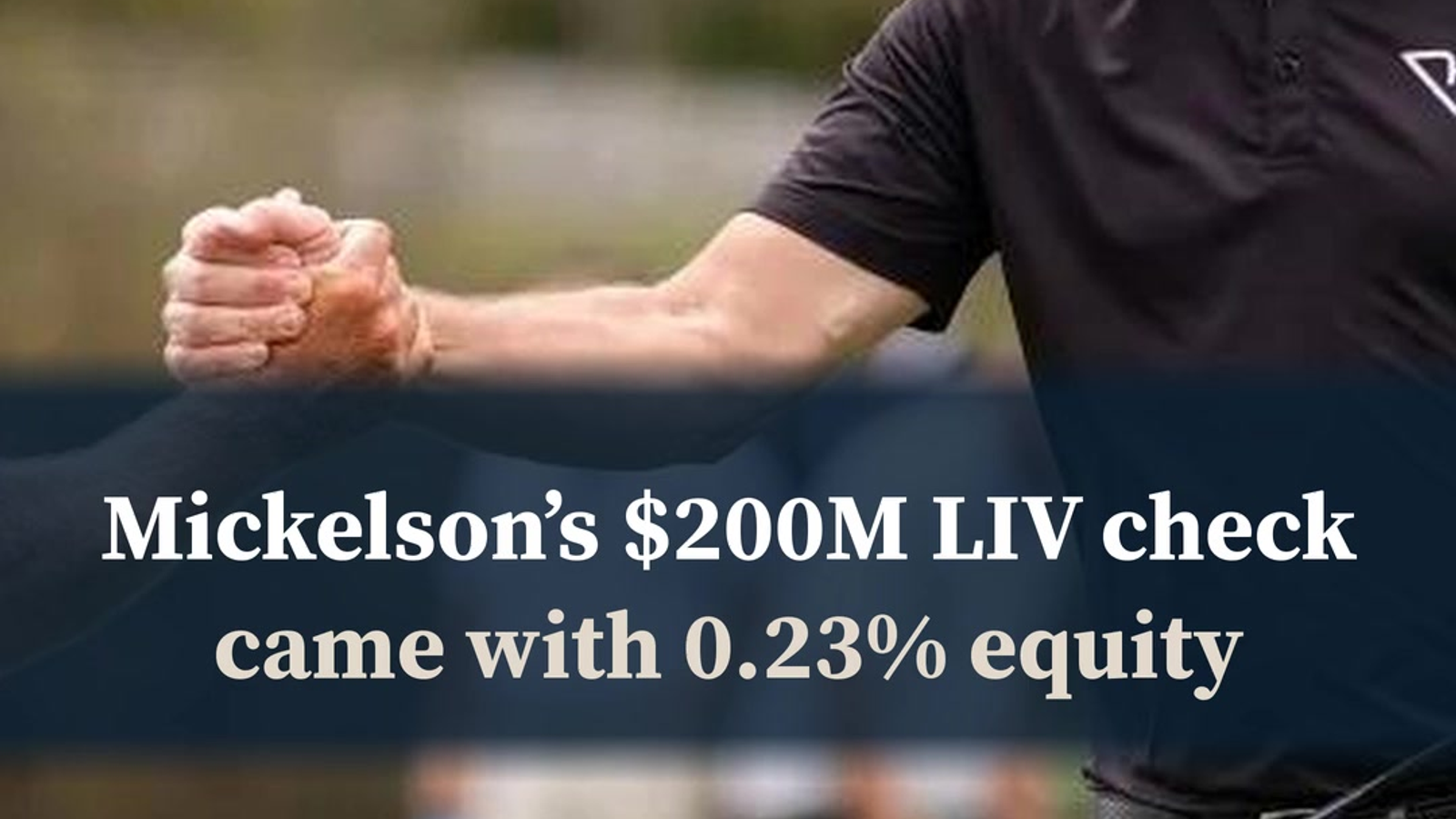
LIV Golf filed for Chapter 11 bankruptcy protection in the U.S. Bankruptcy Court for the District of New Jersey. Sportico, reporting on the filing, identified Phil Mickelson as the unnamed "current player" holding a 0.23% equity stake in the entity, alongside a cap table showing the Public Investment Fund at 98.48%, PIF-controlled Performance54 Group at 1.05%, and former CEO Greg Norman also at 0.23%.
Mickelson signed with LIV in 2022 for a package reported at approximately $200 million, structured as a cash guarantee. He also held a separate 25% stake in the HyFlyers GC team he captained, reported at the same time. The 0.23% stake in LIV Golf itself identified in the bankruptcy filing is distinct from the HyFlyers team stake, and its origin -- whether from the 2022 signing or some later arrangement -- is not established by the sourcing available here.
The filing is the first point at which that bet has been tested against an actual insolvency proceeding rather than against speculation about LIV's prospects. A cap table filed in a Chapter 11 case is not a projection or a reported valuation; it is a document filed with a federal court stating who owns what percentage of the debtor, which becomes directly relevant to how any plan of reorganization treats each class of claim and interest.
That reported $300 million recapitalization is not a separate, uncertain track -- it is a signed Restructuring Support Agreement with BC Partners Credit, filed alongside the bankruptcy petition itself. The term sheet splits the financing into a $127.5 million term loan carrying warrants for 5% of the reorganized entity, $147.5 million in preferred equity carrying warrants for another 10%, and $25 million in convertible notes that would eventually convert to 30% -- putting BC Partners at 45% of the reorganized company, with players collectively holding 52.5% and management 2.5%. The agreement carries a 35-day deadline, running to October 13, 2026, requiring player-creditors representing at least two-thirds of claim value and half of claim count to sign on. PIF, meanwhile, is exiting the company entirely, funding only a $49.6 million debtor-in-possession loan to carry operations through the case.
II. The legal angle
Equity in a company under majority control by one investor is a residual claim, not a payable obligation. In a Chapter 11 priority waterfall it ranks behind unsecured creditors, sitting closer to the bottom of the distribution than the top. It absorbs the first losses when a capital structure fails, and confirms last, if at all, when one succeeds.
Any equity position taken in place of additional guaranteed cash is a bet on enterprise value outrunning a fixed payout — and it is a bet whose downside was always visible in the instrument itself, not hidden in fine print. Whatever the exact mechanism or timing behind Mickelson's 0.23% stake in LIV Golf, that position is what a Chapter 11 filing is now testing. A 0.23% stake in a Chapter 11 debtor is worth exactly what the waterfall says it's worth once the company that issued it can't pay its bills — not because equity compensation is inherently unwise, but because equity, at that rank, was never going to be worth more than the company's remaining value after every senior claim is paid.
The mechanics matter here because the difference between "owed money" and "owns equity" is where this story turns. A creditor has a claim against the estate that gets paid, in whole or in part, before equity holders see anything. Equity holders are last by definition — they own what remains after every other claim is satisfied, and in a filing serious enough to reach Chapter 11, what remains is frequently nothing.
There is a further wrinkle specific to this cap table. PIF holds both the overwhelming equity position, at 98.48%, and is presumably a primary source of any rescue financing or plan funding. A reorganization plan shaped by the party that already owns nearly all the equity and stands to fund the company's exit from bankruptcy is not negotiated the way a plan gets negotiated among diffuse, unrelated equity holders. Whatever recovery flows to the 0.23% lines on that cap table will be shaped substantially by what the majority holder proposes.
III. Follow the money
What matters is the split nobody discusses in public once the headline number lands: guaranteed cash is a claim on the paying entity's bank account regardless of what happens to the company later; equity is a claim on the entity's future value, contingent on that value existing at all. Mickelson's package combined a $200M cash guarantee with equity positions on top of it — the HyFlyers team stake reported in 2022, and the LIV Golf stake the bankruptcy filing now reveals. It is the equity piece, not the guarantee, that a Chapter 11 filing puts to the test.
IV. Who has leverage
Because PIF holds the overwhelming majority of LIV's equity and is presumably a primary source of any rescue financing or plan funding, any reorganization plan it proposes or heavily influences would not be negotiated the same way a plan gets negotiated among diffuse, unrelated equity holders, and recovery to the minority equity lines on the cap table would be shaped substantially by what the majority holder proposes rather than by adversarial negotiation among equal parties.
V. What happens next
Watch the Chapter 11 proceeding for the actual priority order the court confirms -- that is what will settle, as a matter of record rather than reporting, where the 0.23% player-equity line actually sits relative to unsecured creditors.
Claims
16 claims: 11 verified, 5 reported only.
Table of authorities
Authorities cited
Reported sources
16 claims: 11 verified, 5 reported only.
Commentary and analysis, not legal advice. No attorney-client relationship is formed through this content. Descriptions of pending matters reflect publicly reported information as of the publication date.