
The Warriors Can't Stop Paying Porzingis Because He's Sick. They'd Have to Prove He's Refusing.
Golden State changed his status from "general illness" to "not with team." The labor deal sets a $218,341-a-game penalty, but one sentence in his contract bars suspending a player solely for being ill.
I. What happened
Kristaps Porzingis called out of work the day before Golden State's training camp. After an early-October meeting with general manager Mike Dunleavy, he has not been back to the team facility, ESPN's Anthony Slater reports. For weeks the Warriors listed him with a "general illness." The NBA's Oct. 28 injury report now lists him as out, "Not With Team," and Slater reports the change was purposeful: "This can no longer be described as an excused absence." Slater also reports that treating his absence as a failure to render services, and using it to try to void his contract, has been raised inside the organization.
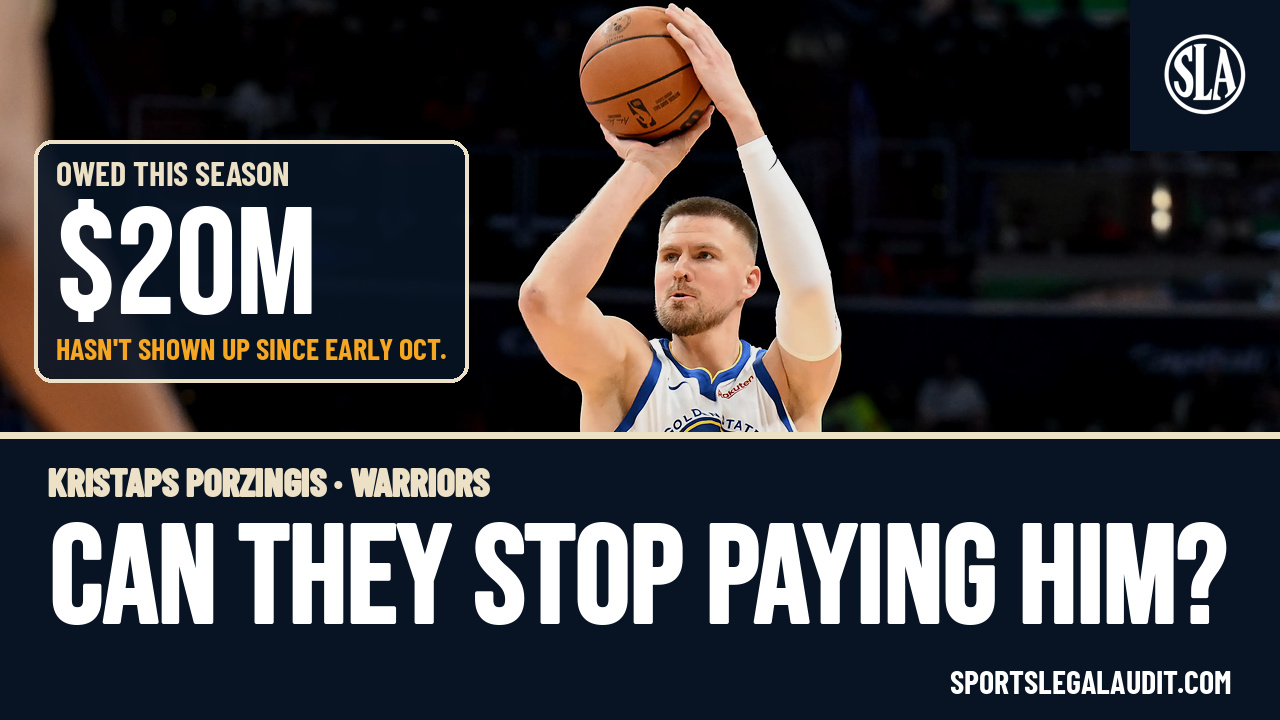
The money is real. Porzingis signed a two-year, $40 million extension in late June. This season pays $20 million, and only $3 million of next season is guaranteed. Golden State is about $20.4 million into the luxury tax, so taking his salary off the books would erase nearly all of that bill. That is the motive. Whether the contract allows it is a different question.
Porzingis has spoken publicly about lingering effects of an upper respiratory viral illness he contracted while with the Boston Celtics, and he has missed 90 games over the past two seasons. Stephen Curry called the situation "a hard one for all reasons," and said it was "hard to talk about without keeping the humanity of it in mind." Steve Kerr: "I don't really have anything else to add on this."
As of Oct. 28, 2026, the Warriors have not announced any fine, suspension, pay withholding or termination, and neither Porzingis nor the NBPA has commented publicly on a grievance.
II. What law or rule controls
Every NBA player signs the same Uniform Player Contract, which is Exhibit A to the 2023 collective bargaining agreement. Four parts of that contract and two articles of the CBA decide this.
The job is more than games. Paragraph 2 defines the services a player owes. They start with "training camp" and "practices, meetings, workouts, and skill or conditioning sessions conducted by the Team," before the games themselves. Staying away from camp and the facility is missing work under the contract, not just missing games.
The pay penalty. Paragraph 6 makes the team withhold pay when a player "fails or refuses, without proper and reasonable cause or excuse, to render the services required by this Contract." The amount comes from Article VI of the CBA: 1/91.6 of base compensation for each game missed. On $20 million, that is $218,341 a game.
The sentence that protects sick players. Paragraph 7(b) lets a team suspend a player the team physician finds unfit, then ends with this: "Nothing in this subparagraph shall authorize the Team to suspend the Player solely because the Player is injured or ill." The same paragraph puts duties on the player. Under 7(d) he must give the team prompt notice of any illness or medical condition, "including, for clarity, any illness or other medical condition related to mental health." Under 7(e) he must submit to examination and treatment by a physician the team designates.
The guarantee and its carve-outs. Paragraph 16's full-salary protection for a player cut while hurt covers an injury "resulting directly from his playing for the Team." An illness is not that. Porzingis' protection is the guarantee in his deal, and the contract's guarantee exhibit carves out conditions tied to a "failure to comply with the requirements of Paragraphs 7(d)-(i)," the notice and treatment rules.
Termination and the arbitrator. Paragraph 16(a)(iv) lets a team terminate a player who "fail[s], refuse[s], or neglect[s] to render his services hereunder or in any other manner materially breach[es] this Contract." A terminated player goes on waivers. Disputes go to a neutral grievance arbitrator under Article XXXI, and pay withheld while a grievance is pending goes into an interest-bearing account.
III. Where does the law stand now
The Warriors have the number. What they don't automatically have is the right to use it. Everything in Paragraph 6 turns on five words: "without proper and reasonable cause." A genuinely sick player staying home is not refusing to work. Illness is the excuse the contract was built to recognize, and Paragraph 7(b) says so in plain terms: the team cannot suspend a player "solely because the Player is injured or ill."
That changes what Golden State would have to prove. The Warriors do not need to show Porzingis is healthy. They would need to show he is refusing. That is a much harder case, and the team's own reporting history makes it harder. For weeks, Golden State itself described the absence as a "general illness." Changing the injury-report label to "not with team" signals the team's position, but a label is not a finding. If the dispute reaches an arbitrator, the question will be what the facts show, not what the report says.
The team's better ground is the player's side of Paragraph 7. A player who is ill still owes the team prompt notice of the condition, including a mental-health condition, and still has to submit to examination and treatment by the team's physician. If Porzingis has refused those, the argument shifts from "he is sick" to "he is not following the rules that come with being sick." That is the route the guarantee exhibit opens, because it carves out conditions tied to noncompliance with Paragraphs 7(d) through (i). As of Oct. 28, 2026, nothing public shows whether he has complied, and that is the fact that would decide the withholding fight.
Voiding the whole contract is harder still. Paragraph 16 does allow termination for a failure to render services or a material breach. But termination starts the fight rather than ending it. Porzingis goes on waivers, the NBPA almost certainly files a grievance, and a neutral arbitrator decides under Article XXXI. Withheld money sits in an interest-bearing account while that plays out. Hoops Rumors summarized the risk as a "prolonged battle with Porzingis and the NBPA." ESPN said voiding "would present its own complications, unless Porzingis expressed an intention to retire and willingly gave all the money back."
The history points the same way. In 2021-22, Philadelphia withheld about $20 million from Ben Simmons during his holdout. He filed a grievance in April 2022, and it settled confidentially in August 2022, with no arbitrator's ruling. In January 2025, Miami suspended Jimmy Butler for "intentionally withholding services," at $532,737 a game, the same 1/91.6 rate. Both disputes ended in deals, not rulings.
The Verdict
Get the clause behind every big sports story.
Every Friday: the week's biggest deals and disputes, each with the provision that decides it and an attorney's verdict. One email, free.
Free when you confirm: my PDF guide, The 10 Clauses Every Athlete Contract Needs.
IV. Who has leverage
Porzingis, for now. He holds a guaranteed $20 million salary, a contract sentence that bars suspension for illness alone, and a union that has every institutional reason to defend that sentence. The Warriors have to carry the burden of proving refusal, and they gave him an illness designation for weeks before changing it.
The Warriors' leverage is narrower but real. They hold the per-game withholding rate, the right to demand notice and examinations by their physician, and the guarantee exhibit's carve-out for a player who doesn't follow those rules. Each refusal to engage with the team's medical staff would strengthen their hand. The tax bill gives them a reason to press.
The trade market currently gives neither side much. ESPN and Hoops Rumors report Golden State has found no viable trade options yet, though the extension was structured to be tradeable.
V. The lawyer's read
Illness is the excuse the contract builds in. To stop paying Porzingis, the Warriors must prove refusal, not health. Voiding the deal is harder still. The realistic exits are a trade, a buyout or a retirement deal.
VI. What happens legally next
Plan A is a trade. Golden State has done this before: in December 2024, it moved an injured De'Anthony Melton and his $12.8 million salary in the deal for Dennis Schroder. Plan B is a buyout, a negotiated reduction of the guaranteed money in exchange for his release. Plan C is a retirement agreement, the outcome ESPN described as the one that would avoid complications.
Watch for four things: any announced withholding or suspension, which would trigger the Article VI rate and almost certainly a grievance; any report on whether Porzingis has given the team medical notice or submitted to its physician's exams; a trade once the market develops; and any public statement from Porzingis or the NBPA. Unless the facts show an unexcused refusal, a voided contract is the long shot.
The full explainer is in the video above. For what "guaranteed" actually means in a pro contract, and where the carve-outs sit, read What Is Guaranteed Money? in the Clause.
Claims
12 claims: 5 verified, 7 reported only.
Table of authorities
Primary sources
Authorities cited
Reported sources
12 claims: 5 verified, 7 reported only.
The Verdict
Want the next one in your inbox?
The Verdict lands every Friday: the week's biggest sports-law fights, what the contract or rule says, and who holds the leverage. Written by a sports attorney.
Free when you confirm: my PDF guide, The 10 Clauses Every Athlete Contract Needs.
Commentary and analysis, not legal advice. No attorney-client relationship is formed through this content. Descriptions of pending matters reflect publicly reported information as of the publication date.